Category: Ash

Kursi Nashin – Facts and Fabrications

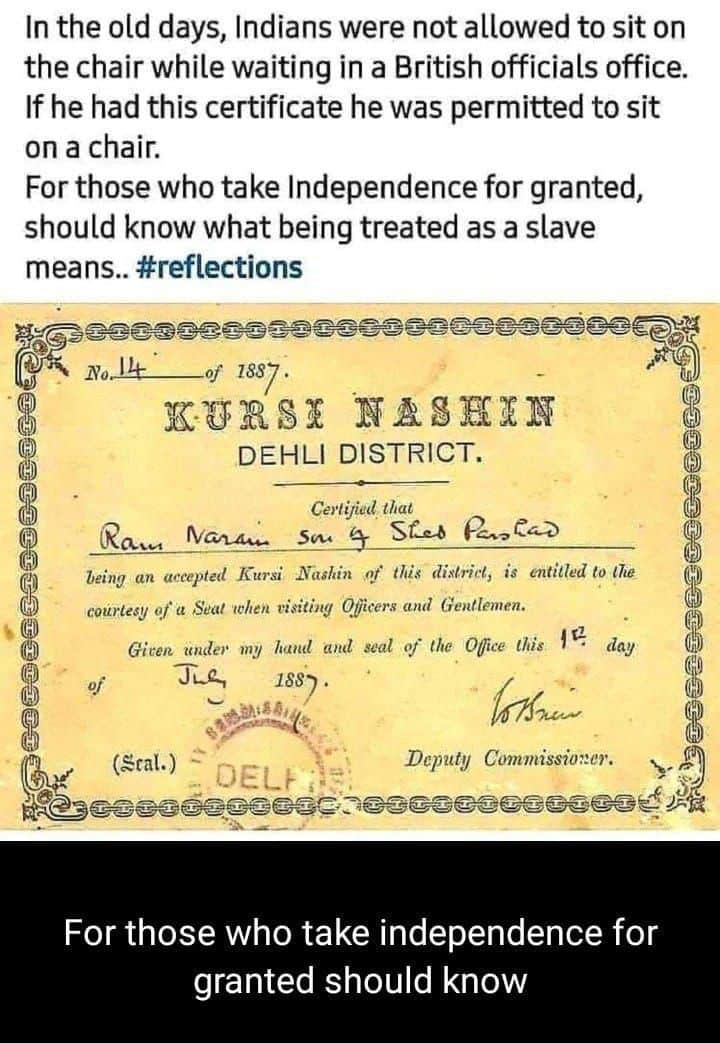
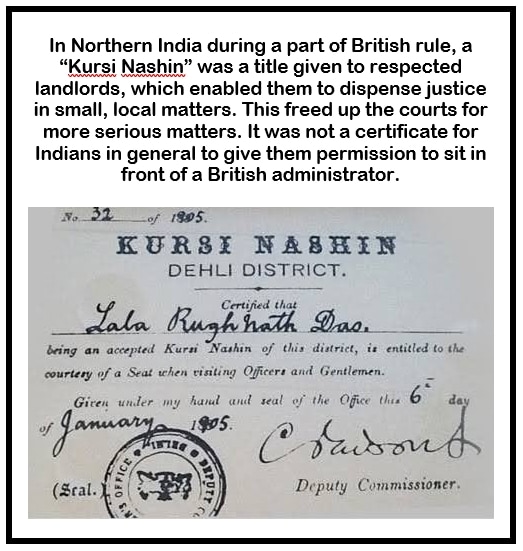
Shareable meme to spread awareness of the real meaning of a Kursi Nashin.
Reading Time: 4 minutes

If your WhatsApp connections are in India, there’s a good chance that you have come across a meme like this. There are plenty of patriots in India, which is a good thing for any country, and some are still fighting the British any way they can. Sometimes, this involves fabricating or bending the truth. By placing inside the container of an image, it becomes easier to circulate. Never let facts get in the way of a good story.

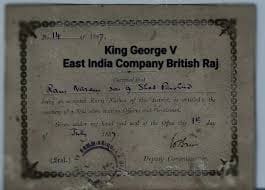
questionable kursi nashin certificate
Questionable document.

Even people such as Harsh Goenka tweeted that image:

Authenticity of the Certificate

Is the above certificate genuine? The position of Kursi Nashin was real, but can you decipher the signature? The the Deputy Commissioner of Delhi District in July 1887 was G.W. Rivaz. He held the position from July 16, 1887, until August 22, 1887. He was preceded by C.M. Rivaz and was succeeded by Edward Brien. The certificate is dated 1 July 1887, while the signature looks like “Brien”. Perhaps this matter was trivial enough for the certificate to be prepared and put aside until Brien had time to sign and issue it.

Who Was Ram Narain?

Ram Narain, son of Sheo Parshad was a prominent figure in Delhi during the late 19th century. He was a Banker and Honorary Magistrate in Delhi.

Ram Narain was a well-known member of the Aggarwal community and came from a family of influential bankers. The family was also active in civic and social affairs. His father, Sheo Parshad, was also a prominent citizen.

Records of Ram Narain, son of Sheo Parshad, appear in:

  • District and Provincial Gazettes: These documents often listed notable residents and their civic roles.
  • Official Correspondence: Letters and reports from British officials in the Delhi district often mentioned him in his capacity as a banker or honorary magistrate.
  • Genealogical and family histories of the Aggarwal community.

His role as a Banker and an Honorary Magistrate would have made him an important figure in the financial and legal life of Delhi during that period.

Origin of the Kursi Nashin

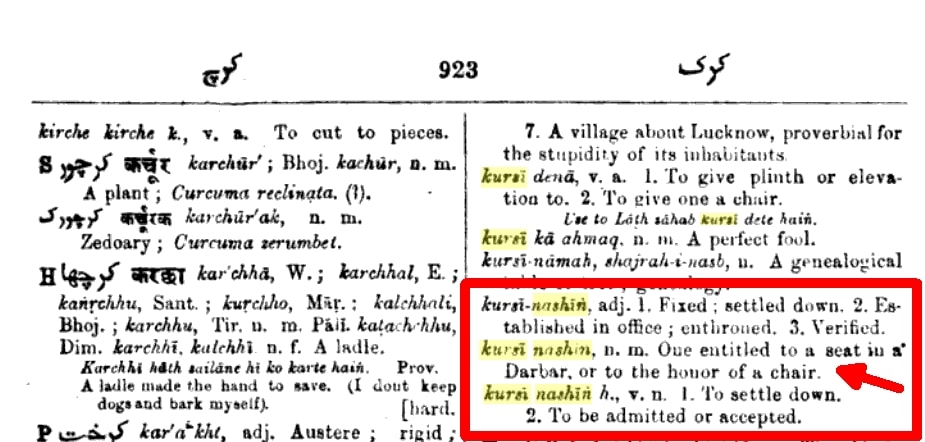
An 1879 reference, “A Hindustani-English Law and Commercial Dictionary” by S. W. Fallon contains the following definition. This dictionary is still in print.

Definition of kursi nashin in 1858
Extract of an Urdu-to-English dictionary.

Kursi Nashin – Noun masculine. One entitled to a seat in a Darbar, or to the honor of a chair.

Samples of this Certificate

Here are some examples found online.

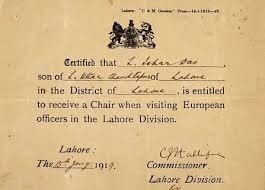
Lahore example of a kursi nashin
Example of a kursi nashin from Lahore
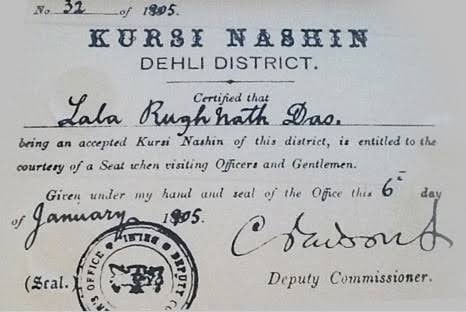
Example of a kursi nashin certificate from Delhi (1)
Example from Delhi (1)

Reductio ad Absurdum

Absurd example of a fabricated kursi nashin

The last, absurd example of the certificate shows a few errors in the mind of its creator:

  • King George V was a mere 22-year-old prince in 1887, when Queen Empress Victoria was on the  throne, and his dad the Prince of Wales and the future Edward VII was getting old, waiting for his mum to pass on.
  • The East India Company had been dissolved in 1883 and removed from the scene in 1858.
  • No certificate had “British Raj” on it.

Other Citations

Here is a citation of a scholarly text.

SINGHA, RADHIKA. “Punished by Surveillance: Policing ‘dangerousness’ in Colonial India, 1872–1918.” Modern Asian Studies, vol. 49, no. 2, 2015, pp. 241–69. JSTOR, http://www.jstor.org/stable/24495402. Accessed 17 Aug. 2025.

Magistrates were advised to ensure that the summary authority vested
in them by sections 109-110 was displayed publicly and ritualistically,
to replenish their authority at outposts of rule. Around November, as
the days became delightfully crisp, the district magistrate would go off
on an inspection tour of police stations, ordering thanedars in advance
to round up the bad characters. It was with the greatest approval that
the Indian Police Commission (1902-1903) cited James Monroe’s
account of how, as magistrate of Jessore, he had conducted enquiries
into bad-livelihood:
I rode out to the spot…. They (the villagers) all sat down and I commenced to
record their depositions on oath …. I had no difficulty in getting respectable
Brahmins, Purohits, traders, etc., to state what they knew.. .the man was
undoubtedly tried by a jury of his countrymen, the Magistrate’s order being
merely the channel…. The accused could point out his field if he said he
lived by cultivation; he could produce his employer if he said he was a daily
labourer … .53
Such occasions gave meaning to the distinctions which the colonial
administration conferred on the loyal and respectable, among them
the kursi nashin (those holding certificates), which entitled them ‘to the
Courtesy of a seat when visiting officers and Gentlemen’. On-the-spot
enquiry was supposed to act as a check on the thanedar’s account, but it
also allowed him to dispose of all section 109-110 cases in one sweep,
avoiding the expense and trouble of dragging suspects and witnesses
to a distant court.

Bench Magistrate

An article titled, “Wadero Ghulam Kadir Dayo: Forgotten Lord of Larkana” has this reference:

In his book Landlord Power and Rural Indebtedness in Colonial Sind, historian David Chessman discusses this, saying, “The British administration introduced a special bench magistrate system to support good governance and writ of law. They were also recognised as chair holders or Kursi Nashin.”

Sufi Saints and State Power

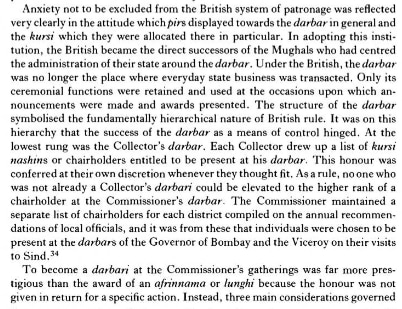
The book “Sufi Saints and State Power – The Pirs of Sind, 1843 1947“, by Sarah Ansari covers the background of Kursi Nashins, on and around page 47-48 (of the book, not the PDF).

Kursi Nashin as explained by Sarah Ansari
Kursi Nashin background, as explained by Sarah Ansari

The term originates from Sufi saints and the seats they were given in Mughal courts. The British Collectors and Commissioners replaced the Mughal darbars. A Commissioner’s Kursi was considered a higher honour than a Collector’s Kursi.

You will find a few Bench Magistrates in other parts of India, while the Kursi Nashin title was used in the North and North-West.

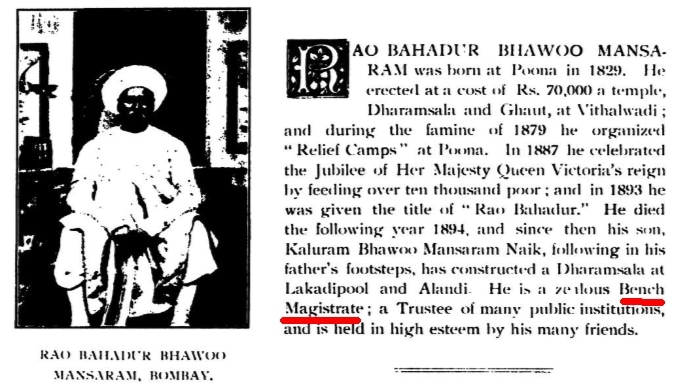
Rao Bahadur Bhawoo Mansaram
Bench Magistrate Rao Bahadur Bhawoo Mansaram of Bombay, an invitee to the Delhi Durbar of 1911.

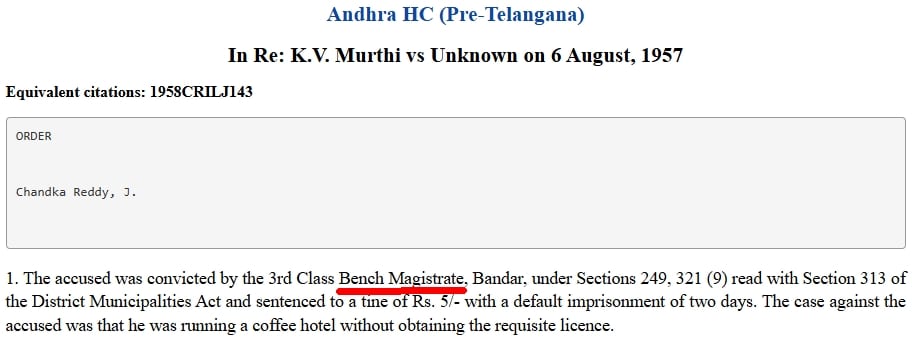
The title of Bench Magistrate carried on well past Independence.

Bench magistrate in Andhra Pradesh
A Bench Magistrate in Andhra Pradesh in 1957.

Therefore, the silly claim by patriots that Indians needed a piece of paper to sit down in front of a British administrator is false.

Handy Meme

Please forward this meme to your WhatsApp groups and add some objectivity to WhatsApp University.

Shareable meme to spread awareness of the real meaning of a Kursi Nashin.

Added: I found a recent article about this with more references:

The Kursi Nashin Certificate: Unveiling Colonial Hierarchies, Patronage, and Humiliation in British India

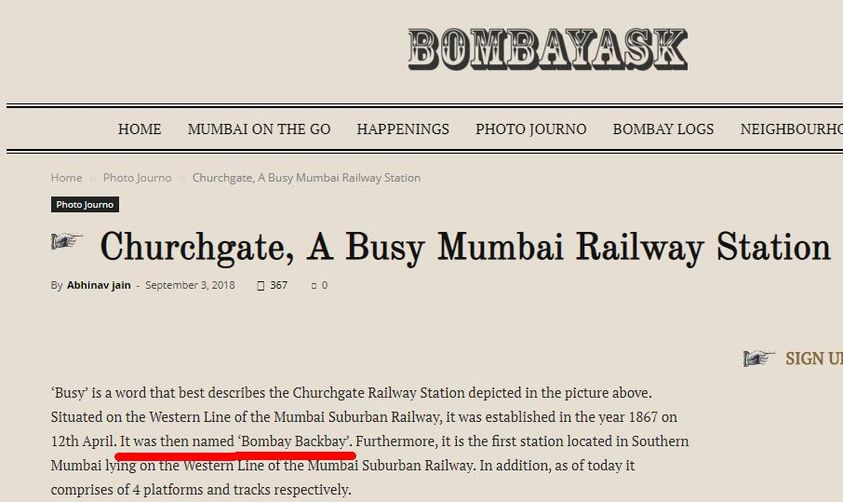
The Mythical Bombay Back Bay Station

Reading Time: 3 minutes

I administer an unlisted Facebook group known as “Bombay, I Remember”. It is a group for reminiscences of its members in the pre-1995 Bombay (when the city was renamed to Mumbai), but nowadays it is kept alive with a lot of historic content about Bombay. Several posts have covered the railway line of the former Bombay, Baroda and Central India (BB&CI) line, particularly the stations at the start of the line.

I have not found any old document that mentions this “Bombay Back Bay” station.

The Bombay Builder

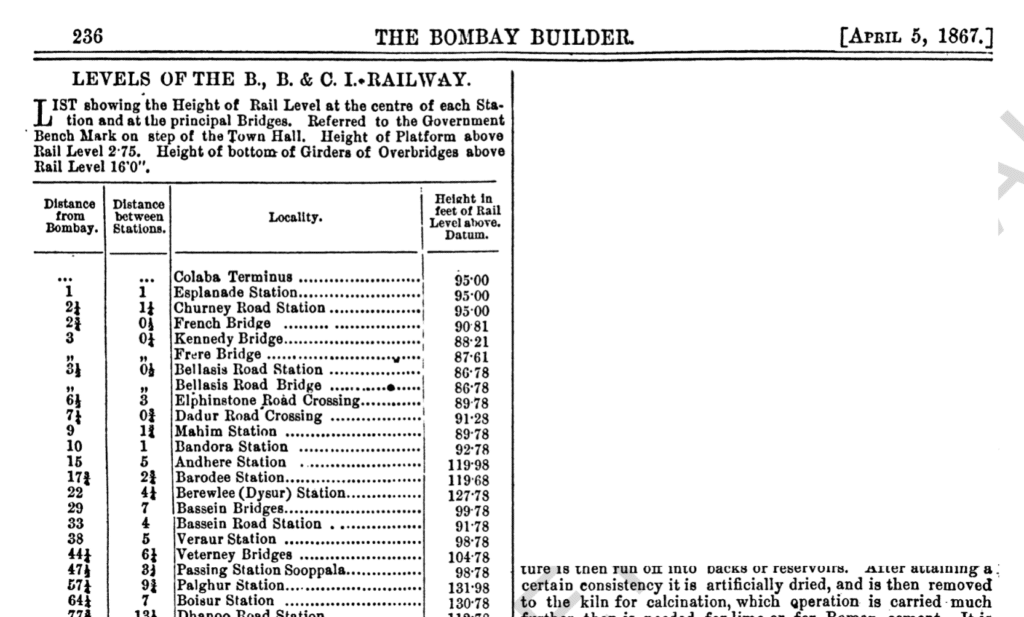
Today, I found an archive of the Bombay Builder covering 1867 at the Asiatic Library’s online archive known as Granth Sanjeevani. The specific page below is dated 5 April 1867. Note that date.

Note the stations in the Locality column.

Two things stood out for me. The terminus at Colaba was there in April 1867. The second station is called Esplanade Station. This is an added mystery, as the Esplanade in those days was too far from this train line to deserve the title. As this is a journal for engineers, they were interested in girders and overbridges, in addition to stations.

Western Railway

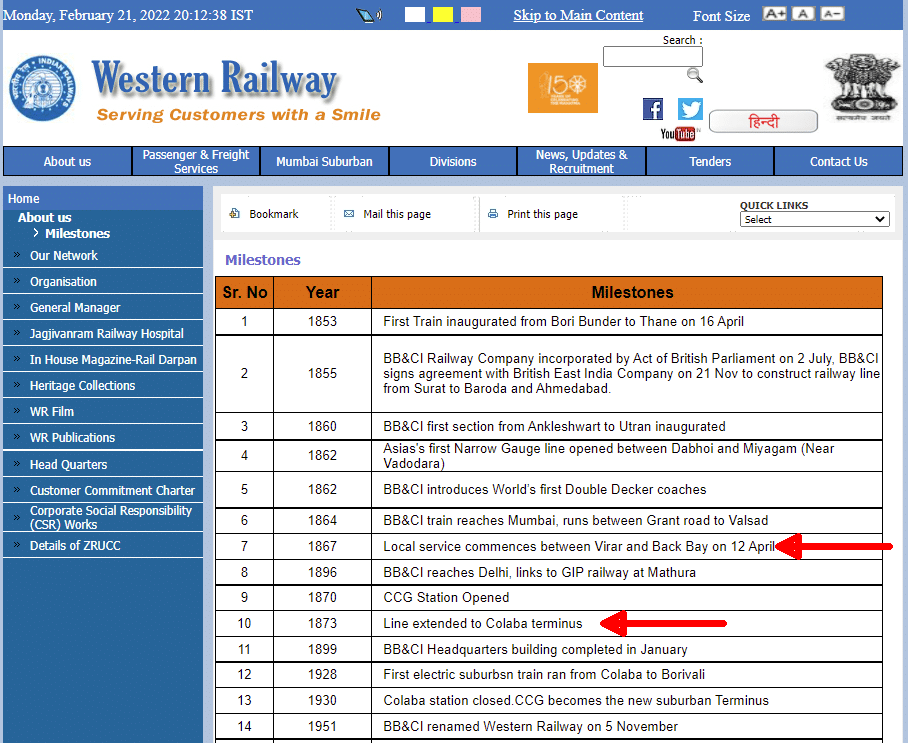
The Western Railway (WR) has been the name of the former BB&CI since 1951, so it should know its own history. Its website is very flaky, so here is a screenshot of its About Us > Milestones page.

WR milestones.
WR milestones.

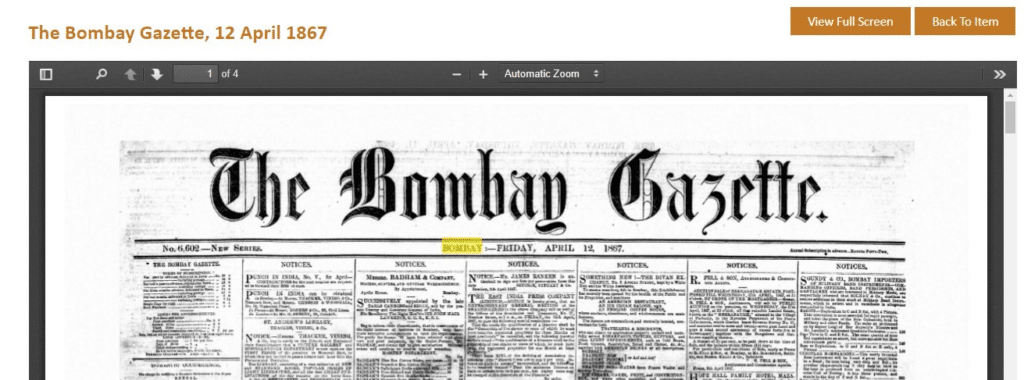
Notice that the WR timeline says the line to Colaba was extended in 1873. How can the earlier reference in the Bombay Builder mention a Colaba Terminus before 5 April 1867? The entry for 1867 mentions the start of a local service between Back Bay and Virar (then spelt Veraur) on 12 April 1867.

I decided to check the newspapers of the day, as scanned by Granth Sanjeevani.

The Bombay Gazette of 12 April 1867.

I checked the date of this new service, the next day and a few days on either side. Not a single mention. Surely a service covering the length of Bombay was worth a mention? BB&CI used to advertise almost daily, but no mention of a new service?

The Wikipedia Entry

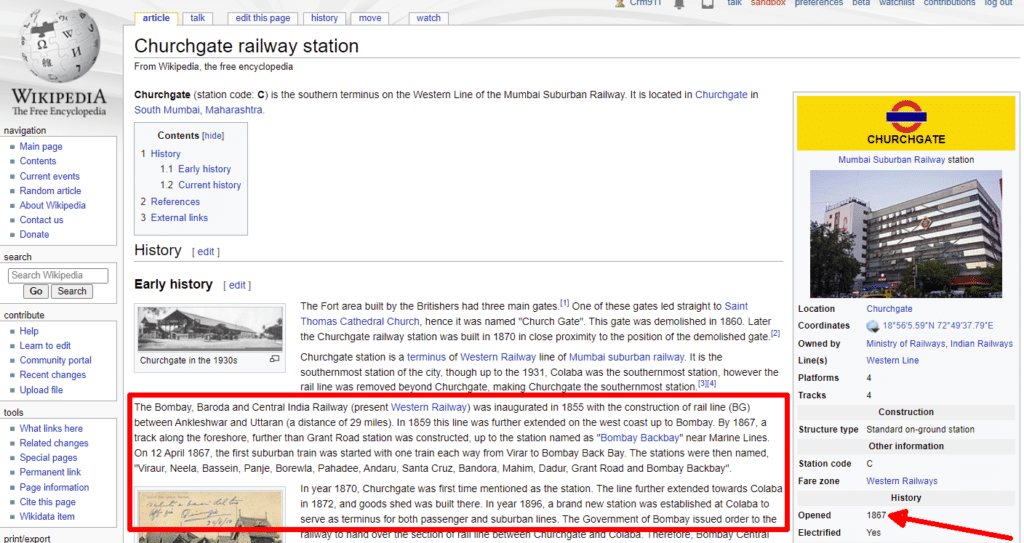
The Wikipedia entry for Churchgate railway station says:

“By 1867, a track along the foreshore, further than Grant Road station was constructed, up to the station named as “Bombay Backbay” near Marine Lines. On 12 April 1867, the first suburban train was started with one train each way from Virar to Bombay Back Bay. The stations were then named, “Viraur, Neela, Bassein, Panje, Borewla, Pahadee, Andaru, Santa Cruz, Bandora, Mahim, Dadur, Grant Road and Bombay Backbay”. In year 1870, Churchgate was first time mentioned as the station. The line further extended towards Colaba in 1872, and goods shed was built there.”

The spellings in those days were quite fluid, so they are a little different from the ones in the Bombay Builder. The unknown Wikipedia contributor has a different date (1872) for the extension of the line to Colaba compared to the WR date of 1873. They mention this mythical “Backbay” (actually two words, Back Bay) station as being “near Marine Lines.

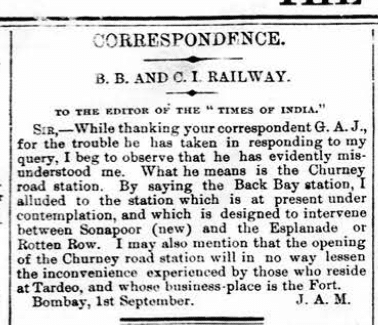
A letter to the editor

The Times of India, 2 September 1868
Letter to the Editor, The Times of India, 2 September 1868

Where does this leave me? I have not found any old document that mentions this Back Bay station. Until I do so, I will treat Back Bay Station as a colloquial reference to Church Gate Station (whose name slowly became one word). If you go to that Wikipedia page for Church Gate Station, you will see that it was opened in 1867!

Wikipedia entry for Church Gate station.

Here is another modern reference to Church Gate being called Back Bay.

Church Gate being called "Bombay Backbay".
Church Gate being called “Bombay Backbay”.

As for the other mystery of an Esplanade Station between Colaba Terminus and Churnee Road (now spelt Charni Road), I think it too is a colloquial reference. Perhaps the engineer who wrote that entry was a brief visitor and wrote it up when back in the UK?

Colaba Station Dates

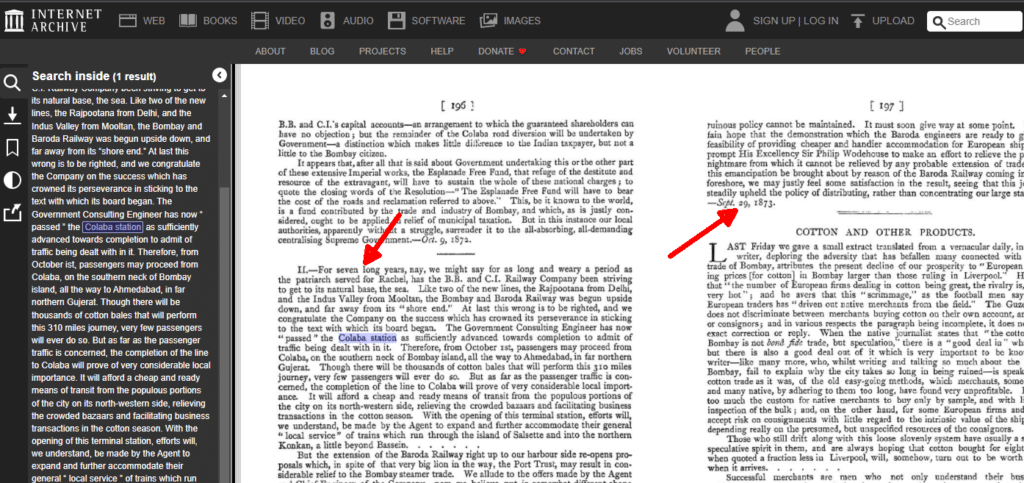
I found this document “Things of India Made Plain, or A Journalist’s Retrospect” by W Martin Wood in the more navigable archive – the Wayback Machine. It mentions in an entry dated 29 September 1873 that the Colaba station was well towards completion that year, after a period of seven years, suggesting that it was started in 1866.

Colaba station took 7 years to be built.

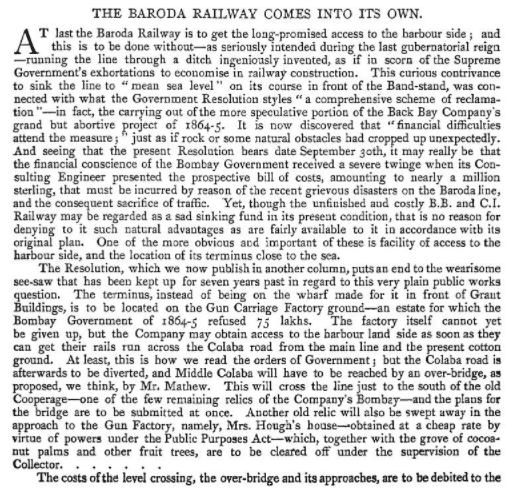
The previous page has an entry dated 9 October 1872, mentioning the procurement of the land for the station.

1872 entry.
1872 entry.

Those words from 1872 suggest that there were railway tracks to Colaba in 1867 (also mentioned by the Bombay Builder), but the grand station was not completed until seven years later. Those tracks carried the cotton to the docks there during the US Civil War and to the Cotton Green. There is a plaque at Bombay Central station that acknowledges a Colaba Causeway station built in 1870 and another reference that the line used to go to Arthur Bunder.

Drive Across the Contiguous 48 United States

Reading Time: 6 minutesThe United States of America is one of my favourite travel destinations. The people there speak a version of English that I understand and they seem to understand me. The natives are friendly and we fight in all wars side by side. A post-retirement trip on my drawing board is the drive across the 48 states that make up the contiguous United States (CONUS); therefore it omits Hawaii and Alaska. This is a drive, not a leisurely sight-seeing journey. Continue reading

Mastodon